Personalized medicine<Providing medication tailored to each individual>
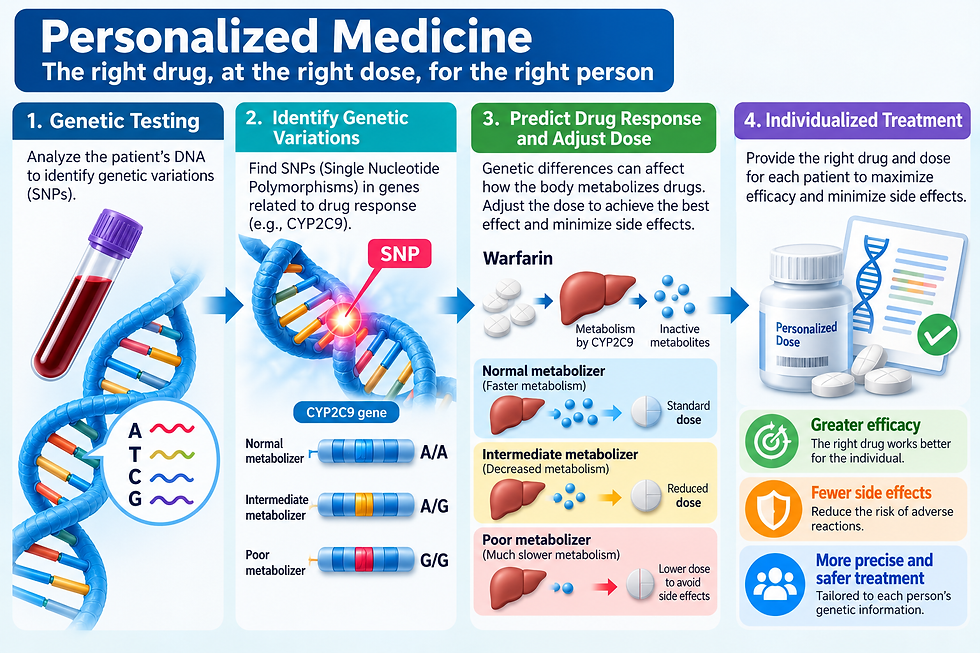
Just as each of us has a different personality, the way medicine works also varies from person to person. The secret to this individual difference lies hidden in our DNA, which is the "blueprint of life."
DNA information is written in the form of sequences of four types of bases: A (adenine), T (thymine), G (guanine), and C (cytosine). The differences in these sequences are what create each individual's unique characteristics.
When comparing the 3 billion base sequences that humans possess, it has become clear that in many cases, even with the same gene (the part of DNA that contains the "design information" for proteins), there is a difference of just one base within it.
This single-nucleotide difference is called a "SNP (Single Nucleotide Polymorphism)."
SNPs subtly influence the function of proteins produced from those genes, and this, in turn, affects how drugs work and their side effects.
Let's look at a specific example: warfarin (brand name: Warfarin®), a drug used for patients with conditions such as myocardial infarction.
The method of administering medication is determined according to each individual's genes.
After warfarin exerts its therapeutic effect, its molecular structure is altered in the liver by an enzyme called "CYP2C9," causing it to lose its efficacy and be excreted from the body.
However, some people have a slightly different CYP2C9 gene. As a result, their CYP2C9 function is weaker.
As a result, warfarin remains in the body for a long time without changing its molecular structure (and thus retaining its medicinal effects).
Because this medication makes blood less likely to clot, if bleeding occurs, a side effect is that it becomes difficult to stop the bleeding.
Therefore, efforts are being made to reduce the risk of side effects by examining the patient's genetic information before administering warfarin and reducing the dosage for patients who meet the criteria.
This approach, which involves examining an individual's genetic information and using that information to predict the effectiveness and side effects of a drug, as well as the appropriate dosage, is called "personalized medicine" or "tailor-made medicine."
Currently, especially in cancer treatment, treatment plans, such as which anticancer drugs to administer and in what quantities, are being determined based on each individual's genetic information.


Comments