A drug that saved hundreds of millions of people
~Looking back at the 2015 Nobel Prizes~
How to get it from the soil next to the golf courseHas the miracle cure of the century been invented?
On October 5, 2015, the Karolinska Institute in Sweden announced that the 2015 Nobel Prize in Physiology or Medicine would be awarded to Dr. William Campbell, Research Fellow at Drew University in the United States, and Dr. Satoshi Omura, Distinguished Professor Emeritus at Kitasato University in Japan. The reason for the award to Dr. Campbell and Dr. Omura was "the discovery of novel treatments for nematode-induced infections." Let's examine the research that received the 2015 Nobel Prize in Physiology or Medicine, focusing on Dr. Omura's work.
When we think of "terrifying diseases," we might picture cancer or heart disease. However, looking around the world, it's infectious diseases that threaten many people.
Infectious diseases are illnesses caused by pathogens that infect humans through other organisms, or from person to person. Pathogens include viruses, bacteria, and parasites. Among these, parasitic infections (parasitic diseases) are estimated to affect more than 2 billion people worldwide, with particularly high rates of severe cases in Africa, Central and South America, and Asia.
The 2015 Nobel Prize in Physiology or Medicine was awarded to three individuals who contributed to the discovery of new treatments for parasitic diseases. Let's look at the process leading up to the development of the drug "ivermectin," which was the result of the work of Dr. Omura and Dr. Campbell.
I am fascinated by the power of microorganisms.
After studying organic chemistry at Yamanashi University, Dr. Omura became a teacher at a part-time high school in Tokyo, where he taught chemistry and physical education. He later enrolled in and completed graduate studies at Tokyo University of Science. In 1963, he joined a research laboratory at Yamanashi University as an assistant, where his research theme was winemaking. Wine is made through the work of microorganisms such as yeast. Dr. Omura stated at a press conference after being awarded the prize that it was during this time that he encountered the amazing power of microorganisms.
After studying abroad in the United States, he began research at the Kitasato Institute that incorporated both chemistry and microbiology. In particular, he focused on "antibiotics," which are compounds produced by microorganisms that kill other microorganisms.
Microorganisms are especially abundant in soil. Then, and even now, Dr. Omura and the other members of his laboratory always carry small plastic bags with them, collecting soil wherever they go. They cultivate the microorganisms living in the soil in the laboratory and analyze what substances they produce.
Of course, soil is home to many types of microorganisms. If we examine the soil as a whole, we won't know what each microorganism is doing. So, first, we dilute the collected soil so that each individual microorganism is separated. Then, we culture the microorganisms on agar containing nutrients. Each separated microorganism divides and multiplies, and eventually a colony of microorganisms grows to a visible size. Since this colony consists of only one type of microorganism, we can then study the characteristics of the microorganism and the substances it produces.
In the 1970s, Dr. Omura focused on a type of microorganism called "Streptomyces," which is a species of actinomycete (a type of bacteria). The name "actinomycete" comes from the fact that its hyphae grow radially (although nowadays they are classified based on genetic analysis). It was known even then that many species in the genus Streptomyces produce antibiotics. The antibiotic "Streptomycin," used to treat tuberculosis, is produced by an actinomycete called "Streptomyces griseus," and the researcher who discovered it, Dr. Selman Waksman, was awarded the Nobel Prize in Physiology or Medicine in 1952.
Dr. Omura had been discovering 2,000 to 3,000 different types of microorganisms annually since that time. In the 1970s, he discovered that about 50 types of bacteria from the Streptomyces genus that he had collected had the ability to produce unknown substances. One of these substances became the catalyst for the development of a drug to treat parasitic diseases. This bacterium was later named "Streptomyces avermitilis." This bacterium was collected from soil near a golf course in Ito City, Shizuoka Prefecture.
Actinomycetes produce medicine for parasitic diseases.
In the 1970s, Dr. Omura was conducting collaborative research with the American pharmaceutical company MSD Co., Ltd. Dr. Omura was responsible for collecting microorganisms and studying compounds, while MSD conducted animal experiments and other related work.
Dr. Campbell, who was affiliated with MSD at the time, specialized in parasitology and used the actinomycetes discovered by Dr. Omura to search for substances effective against parasitic diseases. First, he extracted the culture medium of the actinomycetes. The culture medium contained various substances produced by the actinomycetes. He freeze-dried it and mixed it into the food of mice with various parasitic diseases to see if it reduced the number of parasites. He found that the culture medium of Streptomyces evamitilis had the ability to kill parasites, and that this ability was derived from a substance he named "ivermectin."
While ivermectin was effective against parasitic diseases in animals, Dr. Omura and researchers at Merck & Co. discussed further efforts to enhance its effectiveness. They modified part of the molecular structure of ivermectin and developed "ivermectin," which has almost no side effects. The name ivermectin comes from "dihydroavermectin," meaning ivermectin with two hydrogen atoms added (dihydro), and "vermectin."
A disease in which a large number of parasites are produced in the body.
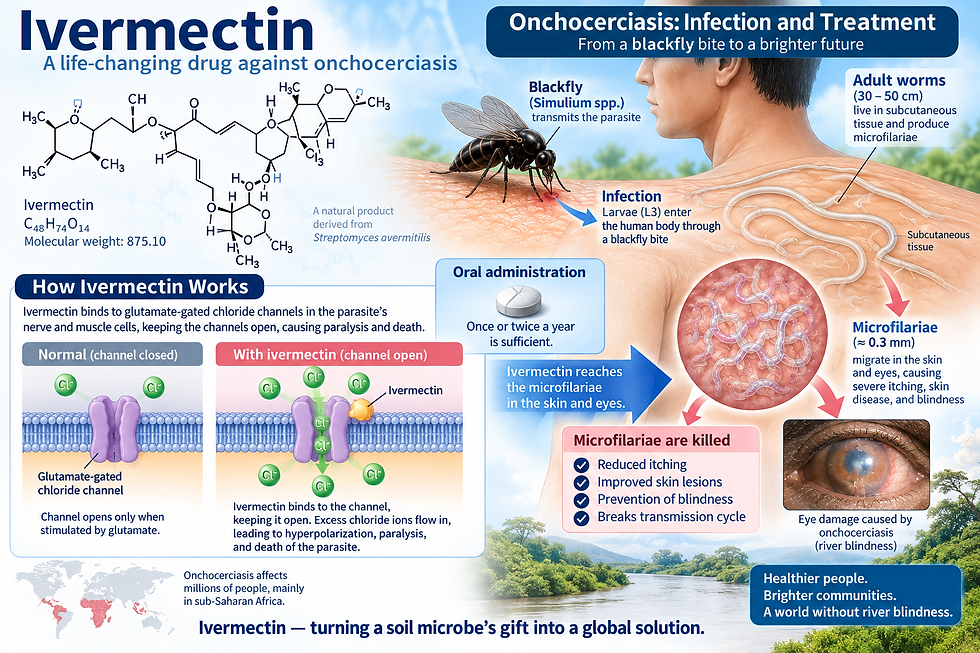
Ivermectin is effective against parasitic diseases such as onchocerciasis and lymphatic filariasis.
Onchocerciasis is an infectious disease caused by a nematode called Richonia serrata, which is transmitted by black flies and infects humans. When a person is bitten by a black fly carrying Richonia serrata larvae, the larvae enter the human body. The larvae are about 1 millimeter long, but when they grow into adults they can reach 30 to 50 centimeters in length and produce about 1,000 microfilariae (their offspring) every day. The microfilariae are about 0.3 millimeters long, but the movement of a large number of microfilariae under the skin causes intense itching.
Furthermore, if microfilariae migrate to the eye, they cause inflammation in the retina, leading to decreased vision and, in the worst cases, blindness. Because it is commonly found along rivers in Africa, where black flies live, onchocerciasis is also known as "river blindness." It is currently estimated that there are more than 25 million patients, and more than 300,000 have gone blind.
Lymphatic filariasis is caused by nematodes such as Dirotia bancroftis, which are transmitted by mosquitoes. When these parasites mature, they inhabit the lymphatic vessels of humans. Lymphatic vessels are tubes that run throughout the body and carry lymphatic fluid that seeps from blood vessels. Microfilariae produced by adult worms damage the lymphatic vessels, disrupting the flow of lymphatic fluid. This can lead to fluid accumulating in certain parts of the body, causing swelling. As the condition progresses, the surface of the skin hardens and the swelling becomes enormous. This condition is called "elephantiasis" because it resembles the skin of an elephant.
Lymphatic filariasis is a parasitic disease that most people contract in childhood and develop in adulthood. It is currently estimated that there are more than 100 million patients. In the past, it was a parasitic disease mainly found in Kyushu, Japan, and it is said that Takamori Saigo also suffered from elephantiasis.
It acts on the muscles and nerves of parasites.
Ivermectin is thought to act on muscles and nerves, including microfilariae that cause onchocerciasis and lymphatic filariasis.
Muscles and nerves use ions to receive and transmit signals from the outside. Ions are atoms that carry a positive or negative electrical charge. The surface of muscle and nerve cells has pathways for ions called "channels," through which ions enter and exit the cell. These channels have doors, which open only when necessary to allow ions to pass through. Normally, the doors are closed, and ions cannot pass through the cell.
Ivermectin is thought to act on channels through which chloride ions pass, causing them to remain open. This free movement of chloride ions, which should be strictly controlled, leads to abnormalities in muscle and nerve function, eventually resulting in the death of microfilariae.
The channels through which ivermectin acts are also present in the nerves of the human brain. However, blood vessels leading to the brain have a function that allows only specific substances to pass through, and it has been confirmed that ivermectin does not reach the brain. For this reason, it has almost no side effects in humans.
Aiming for eradication
For onchocerciasis and lymphatic filariasis, taking ivermectin once or twice a year is sufficient. Because it has very few side effects, it is used not only for treating the disease after it develops, but also for prevention. Thanks to free distribution by MSD, ivermectin is distributed to more than 250 million people every year.
Currently, the number of new cases of onchocerciasis and lymphatic filariasis has decreased significantly.
Ivermectin is also used in Japan to treat scabies, an infectious disease. Scabies is caused by mites that infest the body, resulting in severe itching of the abdomen and chest. It is particularly prone to outbreaks in nursing homes, and more than 100,000 people in Japan contract the disease annually. Ivermectin has been found to be effective against the mites that cause scabies, and is now widely used as a treatment.
Ivermectin is also used as a preventative medication for heartworm disease (commonly known as "filariasis"), a parasitic disease in dogs. If you own a dog, you may have had ivermectin prescribed by your veterinarian.


Comments